


The Senior Planner Advantage
— Wellness Resources —
Hello, beautiful friends!
Wow, what an honor to share the ancient wisdom of Ayurveda with you at IMEX 2026!!
Whether this session was the very first time you ever tapped into these teachings or you’ve been studying for years — you’re in for a life-long journey of playful exploration and abundant health + wholeness. Heck YES.
On the page below, you’ll find:
2 Quick Reference Guides for navigating imbalances in the mind and body
Guided Breathwork Sessions to counter-balance your Stress Imprints
Advanced Learning Opportunities to go deeper on your wellness journey
Enjoy the following resources as you continue diving into this potent medicine!
And of course, please don’t hesitate to email me monica@soulbare.com or connect with me on LinkedIn if you have questions.
Handouts

A more in-depth discussion of how to implement Balancing the Body through the Six Tastes of Ayurveda is at the bottom of this page.
AYURVEDA HOT TIP:
It’s very possible for the mind and body to be experiencing a different Dosha imbalance. For example - you may be feeling anxious/overwhelmed in the Mind (Vata), but hot/inflamed in the Body (Pitta). This is normal and common!
In the case of this example, you would follow the Vata Mind protocol and the Pitta Body protocol.
Breathing for Balance
Click the images to access the practices.
Balancing VATA
Use this grounding, calming practice in moments of anxiety, worry, and overwhelm

Balancing PITTA
Use this cooling, soothing practice in moments of frustration, impatience and judgement

Balancing KAPHA
Use this invigorating, energetic practice in moments of avoidance, stagnation and complacency

Advanced Learning Opportunities

The Energy Audit
A 90-minute Ayurvedic insight session designed to help you understand what’s really happening beneath the surface of your health, wellness, and energy levels.

Wisdom of the Elements Adventure Retreat
Ring in 2027 with the experience of a lifetime!
Expanded Resource:
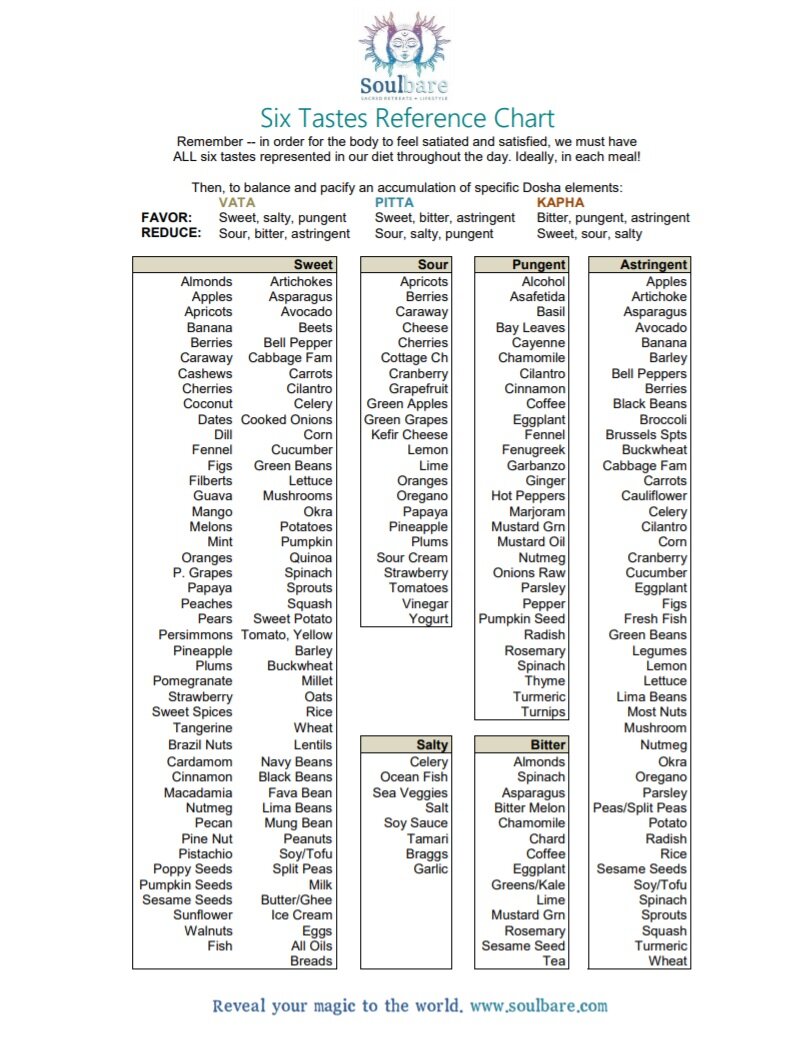
The Six Tastes of Ayurveda
Ayurveda teaches us that in nature, foods fall into six categories of tastes—sweet, sour, salty, bitter, pungent, and astringent. These six tastes occur organically in the natural world and, because our bodies are fine-tuned to resonate with nature, we know intuitively and internally that we must include all six tastes in our diet to feel satiated and satisfied.
This is a very important concept in Ayurveda that sets it apart from many other nutritional systems—in Ayurveda, it is never about NOT. Essentially, what this means is that there is no natural food that we should eliminate entirely from our diet because we need all six tastes to feel fully supported. Rather, we use the terms and behavior of favor and reduce. We place more attention on favoring three of the tastes and reducing the others, but do NOT eliminate them entirely.
Physicality aside, this is a true hero when it comes to the psychology of eating. Often, when we feel like we are forbidding ourselves from a certain taste or experience, we eventually cave and indulge in it to an extreme. Ayurveda says we truly can have it all, so long as we pay conscious attention to the proportions that best serve us.
Each of the tastes contains an expression of the five Mahabhutas (space, air, fire, water, earth) so, naturally, some tastes will be pacifying to your dosha and others may aggravate it if you add too much. Remember that, in Ayurveda, opposites attract and lead to harmonic balance in the body/mind!
The Six Tastes In Ayurveda
The general categorization of the six tastes are:
SWEET [Water + Earth] – anything carb-related (grains, rice, oats, breads, all potatoes, etc), nuts, all dairy and non-dairy milks, sweet fruits and meats
SOUR [Fire + Water] – citrus fruit, fermented dairy (yogurt, kefir, cheese, etc), berries, nightshades, vinegar, alcohol
SALTY [Fire + Earth] – all salts (Himalayan, black, sea, etc), ocean fish/crustacean, seaweed, soy sauce
BITTER [Space + Air] – turmeric, coffee, almost all green and yellow vegetables, tea
PUNGENT [Air + Fire] – all pepper (black, cayenne, jalapeno, etc), ginger, garlic, onion, cinnamon, fennel, mustard
ASTRINGENT [Air + Earth] – all beans (garbanzo, black, kidney, etc), banana, legumes, peas, berries, most vegetables
With our new-found understanding of the imprint of each food group and our own doshic makeup, we can apply this knowledge in deciding which foods to favor and reduce throughout the day. If you find it cumbersome or challenging to balance the six tastes into each meal, make sure you at least incorporate each of them at some point throughout the day to satiate your body’s cravings for harmony with nature.
VATA // Body Imbalance
An accumulation of Space + Air creates a digestive experience of Bloating, Gassiness, and Constipation.
Temper with qualities Fire, Water + Earth to influence effects that are Warming, Comforting, and Moistening.
Favor: Sweet, Sour, Salty
Reduce: Bitter, Pungent, Astringent
Pro Tip: Avoid raw, uncooked foods as they will add undesirable cool, drying qualities to your constitution. Vatas need to comfort and heat the body with warm soups and cooked meals.
Daily Dose of Balance: Drink a cup of fennel tea to combat gassiness and bloating and aid digestion.
PITTA // Body Imbalance
An accumulation of Fire + Water creates a digestive experience of Acid Reflux, Heartburn, and IBS.
Temper with qualities of Space, Air + Earth to influence effects that are Soothing, Cooling, and Sweet.
Favor: Sweet, Bitter, Astringent
Reduce: Sour, Salty, Pungent
Pro Tip: Though pittas tend to love a good spicy meal, it’s best to avoid this type of food that will add unnecessary warmth to an already heated constitution.
Daily Dose of Balance: Drink a cup of turmeric tea to reduce inflammation throughout pitta’s constitution. For bonus points, make with coconut milk as this tropical fruit will create an added cooling effect.
KAPHA // Body Imbalance
An accumulation of Water + Earth creates a digestive experience of Sluggishness, Slow Digestion, and Diarrhea.
Temper with qualities of Space, Air + Fire to influence effects that are Stimulating, Lightening, and Warming.
Healing Kapha through TASTE
Favor: Bitter, Pungent, Astringent
Reduce: Sweet, Sour, Salty
Pro Tip: As kaphas are all about support and coziness, they do enjoy a good comfort-food inspired meal. However, this traditionally heavy food adds congestion to the already sluggish system. Kapha should experiment with adding more spice and raw foods to lighten and enliven the system.
Daily Dose of Balance: Drink a cup of ginger tea each morning AND afternoon to stimulate your digestion and metabolism and boost the presence/function of agni.